
Wes Anderson’s latest film, The Phoenician Scheme, may be the most visually composed film about mass death and legacy guilt ever made. Set in a fictionalized 1950s postwar landscape, it tells the story of Anatole “Zsa-Zsa” Korda, a flamboyant weapons magnate with six failed assassination attempts behind him, who decides—upon suspecting a seventh is near—that it’s time to hand off his empire to his estranged daughter, Liesl, a nun with no interest in blood money. The result is an immaculately designed meditation on empire, capital, faith, and family trauma that’s as unsettling as it is hypnotic.
Anderson has always been a director of contradictions—whimsy blended with sorrow, artificiality used to tell hard truths—but The Phoenician Scheme pushes those contradictions into new territory. For every symmetrical tracking shot and pastel hallway, there’s a machete fight, a religious monologue, or a moment of brutal clarity about the world’s reliance on organized violence. It’s less about narrative cohesion and more about thematic confrontation: how do we survive inside systems we know are wrong?
The movie is drenched in Anderson’s signature aesthetic—shot on 35mm in a 1.5:1 aspect ratio by Bruno Delbonnel—but this time that precision frames war rooms, refugee encampments, and luxury bunkers. Everything is painted with the same lush, handmade detail, and that’s exactly the point. As Korda himself says, “If you can’t make a death machine look good on camera, what’s the point of owning one?”
A Cast That Knows It’s in a Theatre of War
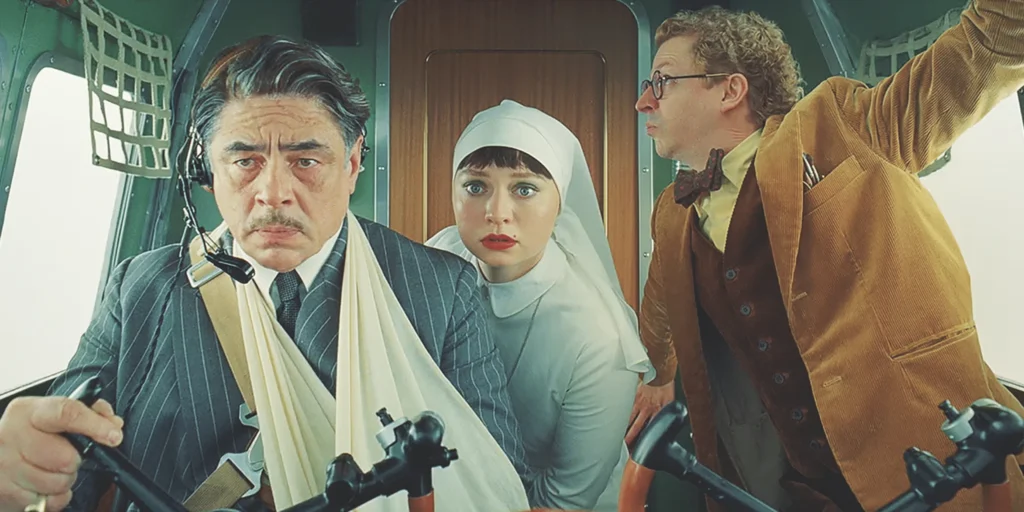
Benicio del Toro gives one of his most internal, restrained performances as Korda—a character clearly inspired by historical arms dealers like Basil Zaharoff and fictional ones like Tony Stark without the redemption arc (yet). Del Toro plays him like a dying lion: dangerous, reflective, often funny, and always theatrical. His chemistry with Mia Threapleton, playing his daughter Sister Liesl, is brittle but rich. Threapleton manages to be the emotional core of the film without ever raising her voice—her moral compass never wavers, even when the plot does.
Michael Cera, playing Liesl’s reluctant tutor, Bjorn, is one of the film’s quiet surprises. Insect-obsessed and emotionally constipated, he acts as both comic relief and moral echo chamber, repeatedly asking, “Are we really doing this?” even as he clutches a grenade launcher.
The ensemble is as stacked as you’d expect in a Wes Anderson film, and most actors appear for a single, pointed sequence: Bryan Cranston plays a Swedish diplomat in a knife-throwing contest; Scarlett Johansson is a debt collector for a Vatican shadow bank; Riz Ahmed plays a revolutionary poet smuggling weapons through religious art. Each character is sharply drawn and dropped like a puzzle piece into the sprawling tableau.
Tom Hanks, Jeffrey Wright, Benedict Cumberbatch, and Willem Dafoe round out a supporting cast of political, spiritual, and mercenary figures who represent the many faces of power. Bill Murray appears as a metaphysical narrator in a quasi-celestial realm, acting as both chorus and comic relief in the film’s surreal cutaways. Whether he’s playing God or just another hallucination, the film never tells.
The Plot That Defies the Clock
Clocking in at just over two hours, The Phoenician Scheme is dense, not long. It jumps across time zones and plotlines without warning. After Korda survives his sixth assassination attempt on a malfunctioning charter plane—an explosion rendered in elegant slo-mo with midair tea trays—he retrieves Liesl from her cloister. She refuses to accept her inheritance, but agrees to travel with him on “a last negotiation tour.”
Their journey takes them through a series of increasingly surreal and morally compromised deals. In one, Korda sells military helicopters to a rebel state through a puppet opera. In another, he secures uranium mining rights by staging a fake execution for the press. Liesl, meanwhile, records every detail in a leather-bound diary she intends to burn at the end. Or maybe publish.
The film’s midpoint includes an extended desert-set siege that’s been compared to both The Grand Budapest Hotel and Lawrence of Arabia—a kind of pastel war epic where mercenaries read poetry between gunfire. The climax is surprisingly quiet: a courtroom without walls, in which Liesl testifies not against her father, but in his favor, stating plainly: “He taught me what not to become. And that’s worth something.”
Themes That Cut Deeper Than the Set Design
At its heart, The Phoenician Scheme is about the lies we tell ourselves to justify wealth, war, and tradition. Liesl is a character who believes in truth. Korda is a character who believes truth is just good branding. Their interactions are a masterclass in moral tension.
Anderson explores:
- The false equivalence between inheritance and destiny
- How faith functions in capitalist systems
- The aesthetics of death and how they’re used to sell violence
- Redemption—not as absolution, but recognition
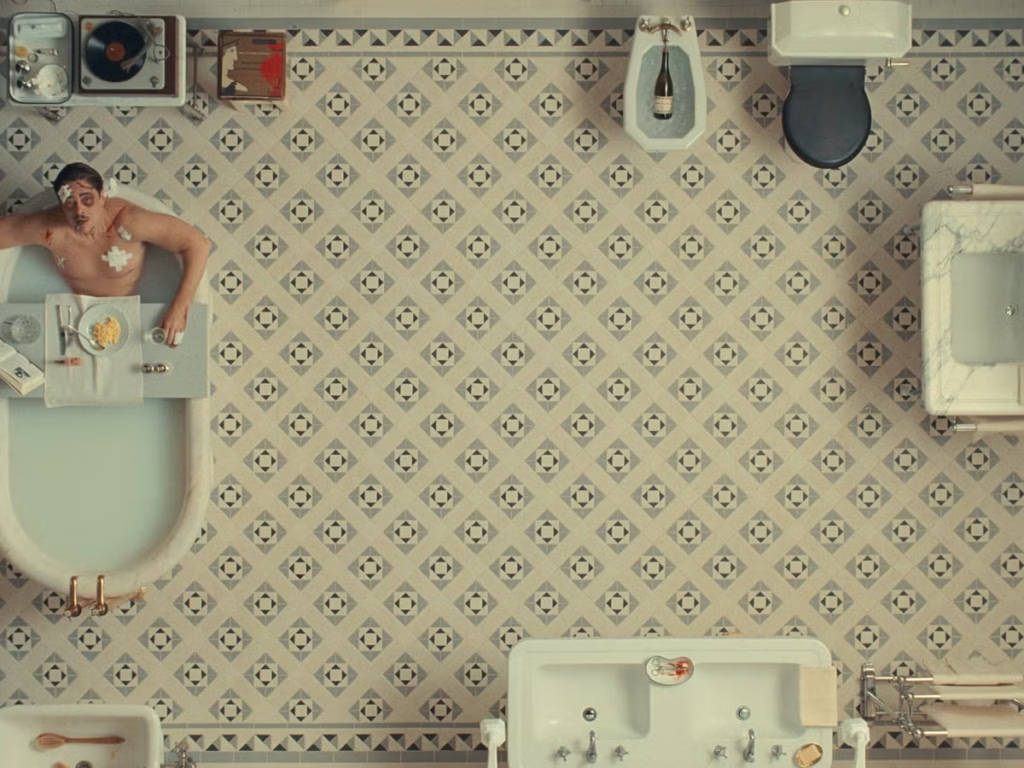
Critics have called the film Anderson’s most spiritual work yet, and it’s hard to argue. Despite its explosions and body count, the soul of the movie is in its quietest moments—when Liesl washes blood off her hands in a sink shaped like a swan; when Korda sits in a bathtub filled with telegrams; when a child soldier quietly steals a packet of seeds from an arms deal gone wrong.
What the Critics Are Saying
Reception has been largely positive, though divided. RogerEbert.com praised the performances and noted Anderson’s maturity, calling the film “an operatic reckoning disguised as a comedy of manners.” The Guardian noted how the film “fantasizes real global trauma into parable without losing weight.” Meanwhile, Empire was more cautious, admiring the craft but finding the script “more fractured than profound.”
Still, the Rotten Tomatoes score remains strong, hovering around 78%, and box office numbers have exceeded expectations for a film this stylized.
If You Liked The Phoenician Scheme, Try These:
- The Grand Budapest Hotel — Anderson’s other foray into global politics and grief
- The Death of Stalin — political satire meets ensemble chaos
- Children of Men — a gritty, grounded portrait of societal collapse
- Burn After Reading — for bureaucratic absurdity and dark humor
- The Constant Gardener — global conspiracy, morality, and personal stakes
- Asteroid City — for the theatre-like structure and nested realities
- Syriana — power, oil, and betrayal in the Middle East
- Moonrise Kingdom — Anderson’s lighter moral parable with spiritual undertones
FAQ
Is this Wes Anderson’s darkest film?
Yes, by far. While it’s not horror, the themes and visuals are more mature, violent, and direct than anything since The Darjeeling Limited.
Do I need to know Anderson’s other work?
No, this stands alone, but fans will catch stylistic callbacks and thematic echoes.
Is it political?
Unapologetically. It critiques arms dealing, colonialism, and religious hypocrisy—though through allegory and satire.
Is it hard to follow?
A bit. The narrative is more fragmented than usual. It rewards patient, attentive viewing—and rewatching.
Is it worth seeing in theaters?
Absolutely. The cinematography and sound design deserve a large screen, especially for the war sequences.