
Table of Contents
- Introduction
- About the Book
- Ray Dalio’s Big Cycle Framework
- Historical Case Studies
- Key Themes and Insights
- Writing Style and Accessibility
- Strengths of the Book
- Critiques and Considerations
- The Big Cycle in Today’s Context
- Who Should Read This Book?
- Comparison to Similar Works
- Final Verdict
- About the Author
- Similar Books You Might Enjoy
Introduction
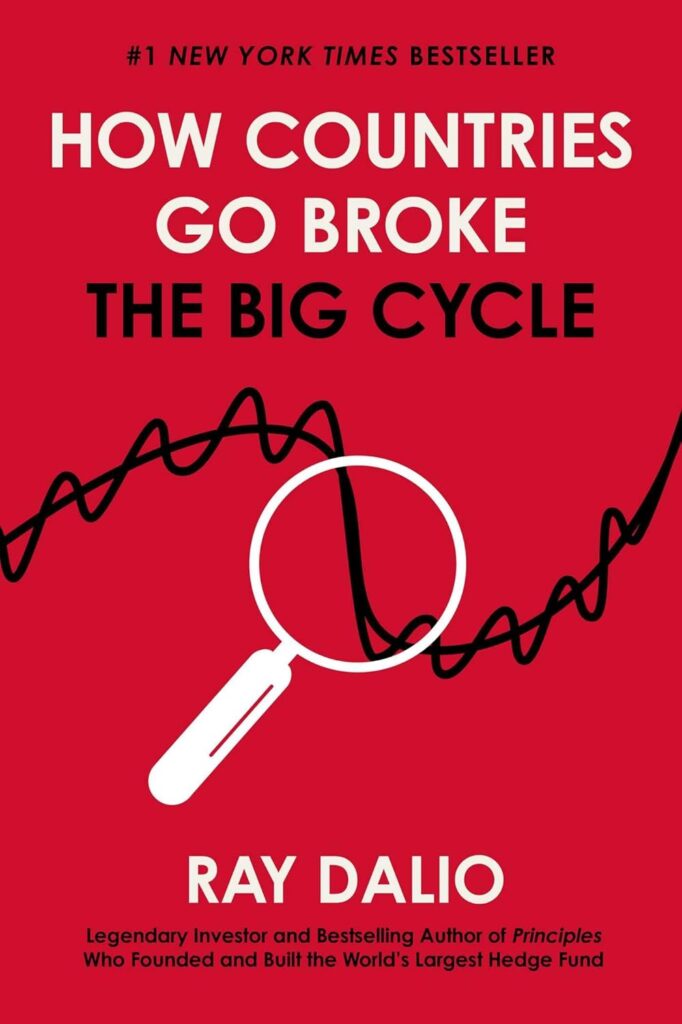
If you’ve ever wondered why some countries rise to global dominance while others collapse under crushing debt, inflation, or social unrest, Ray Dalio’s How Countries Go Broke: The Big Cycle offers a sweeping, deeply researched answer.
Dalio, founder of Bridgewater Associates and author of Principles and Principles for Dealing with the Changing World Order, has long argued that economies move in predictable “big cycles.” This new book, released in June 2025, represents his most ambitious attempt yet to explain how nations prosper, decline, and reset themselves—and what lessons we can learn before history repeats itself.
How Countries Go Broke is not just an economics book. It’s a global history of finance, power, and human behavior, with case studies spanning empires and centuries. But it’s also a warning. In Dalio’s view, the U.S. and much of the developed world are deep into the late stages of the cycle—and the decisions we make in the next decade will determine whether we face decline or renewal.
This review will unpack the book’s main arguments, highlight its strengths and critiques, and ultimately help you decide whether Dalio’s Big Cycle framework is a lens worth adopting in how you think about money, politics, and the future.
About the Book
At nearly 600 pages, How Countries Go Broke is structured as both a theory of cycles and a collection of historical case studies.
- Part One lays out Dalio’s “Big Cycle” model. He argues that nations go through repeating stages of growth, overextension, debt accumulation, and eventual collapse.
- Part Two digs into history: Rome, the British Empire, the Dutch Republic, the U.S., China, and emerging markets.
- Part Three looks at today’s challenges—rising debt, populism, geopolitical tension—and maps them onto his cycle framework.
Dalio’s goal is not just academic. He wants policymakers, investors, and ordinary readers to see the warning signs of decline early enough to act. In this way, the book functions almost like a manual for preventing disaster, not just recording it.
Ray Dalio’s Big Cycle Framework
Dalio’s central contribution to economics is the concept of the Big Cycle—a repeating pattern of national rise and decline that spans 75–150 years. Unlike the shorter business cycles most people are familiar with, the Big Cycle looks at long-term structural shifts driven by debt, productivity, and geopolitics.
The Rise of Nations
Nations typically rise when they have:
- Strong education and innovation systems (producing productivity growth).
- Stable political institutions (which attract investment).
- Sound money and credit systems (avoiding runaway inflation).
- Global competitiveness (exports, trade dominance).
Dalio points to the Dutch Republic in the 1600s, Britain in the 1800s, and the U.S. after WWII as prime examples. Each became the world’s reserve currency issuer and military leader at their peak.
The Debt Cycle
The Achilles heel of every dominant nation is debt. Success breeds complacency, leading to:
- Excess borrowing by governments, businesses, and households.
- Asset bubbles and speculation.
- Currency debasement (printing money to cover shortfalls).
Dalio argues that the late stage of the cycle is marked by high inequality, political polarization, and declining competitiveness. The country becomes addicted to debt just to maintain its standard of living.
Decline and Reset
Eventually, the debt burden becomes unsustainable. Nations face hard choices: default, inflate away the debt, or restructure. Historically, this often comes alongside:
- Rising populism and social unrest.
- External challengers exploiting weakness.
- Loss of reserve currency status.
At this point, the system “resets.” Sometimes that means painful collapse (like Rome), other times managed reform (like Britain’s post-empire transition). The question for Dalio is: where does the U.S. fit today?
Historical Case Studies
Dalio grounds his theory in vivid examples.
Rome
Rome rose through military dominance and trade, but collapsed under the weight of military spending, political corruption, and debased currency (diluting silver coins to fund deficits). The lesson: when a government finances itself by hollowing out its currency, decline is inevitable.
The British Empire
Britain’s industrial revolution made it the world’s superpower. But by the early 20th century, debt from World War I, colonial overreach, and competition from the U.S. and Germany pushed it into decline. The pound sterling lost its role as the world’s reserve currency to the U.S. dollar after WWII.
The Great Depression & U.S. Cycles
Dalio revisits the 1930s, noting eerie parallels to today: high inequality, rising populism, trade wars, and global conflict. The New Deal and WWII effectively “reset” the U.S. system, but at great cost.
Modern Emerging Markets
From Argentina to Turkey, Dalio shows how debt and currency crises continue to plague nations. He warns that these aren’t “third world problems”—they’re symptoms of the same cycle every major power faces.
Key Themes and Insights
- Debt is destiny. Every empire falls not just because of external enemies, but because of internal financial rot.
- Reserve currencies don’t last forever. The dollar’s dominance is not permanent; China is rising.
- Human behavior is cyclical. We forget past crises and repeat them.
- Inequality fuels instability. When wealth gaps widen, populism rises.
- Education and innovation are long-term saviors. Countries that invest here can reset without collapse.
Writing Style and Accessibility
Dalio is a billionaire hedge fund manager, but his writing is surprisingly approachable. He uses charts, diagrams, and plain language to make complex economics digestible.
At times, the book feels like a hybrid between a college history class and an investor’s memo. It’s not light reading, but it’s not buried in jargon either. If you’ve read his earlier Principles books, you’ll find a similar blend of data and narrative.
Strengths of the Book
- Ambitious scope. From Rome to modern China, the historical sweep is impressive.
- Clear framework. The Big Cycle gives readers a mental model for understanding the news.
- Timely relevance. With U.S. debt at record levels, Dalio’s warnings feel urgent.
- Visual aids. Charts and timelines make abstract concepts concrete.
Critiques and Considerations
- Deterministic tone. Some critics may argue Dalio makes history seem too predictable.
- U.S.-centric lens. While global, the narrative often returns to America.
- Prescriptive advice is light. He diagnoses decline well, but offers fewer concrete solutions for policymakers.
- Length. At nearly 600 pages, it can feel overwhelming.
The Big Cycle in Today’s Context
In 2025, Dalio’s warnings resonate more than ever. U.S. debt is over 34 trillion, interest payments rival defense spending, and political polarization is extreme. Meanwhile, China is rising, and global alliances are shifting.
Dalio doesn’t claim to predict exact dates, but he argues the patterns are unmistakable. The U.S. is in the late stage of the Big Cycle—and the coming decade will test whether it declines like Rome or adapts like Britain.
Who Should Read This Book?
- Investors. Understanding long-term cycles is essential for markets.
- Students of history. Dalio connects economics and geopolitics seamlessly.
- Policymakers. This is a wake-up call for fiscal responsibility.
- General readers. If you want to understand headlines about debt, inflation, and geopolitics, this book is invaluable.
Comparison to Similar Works
- This Time Is Different by Reinhart & Rogoff
- The Ascent of Money by Niall Ferguson
- Capital in the Twenty-First Century by Thomas Piketty
- The Changing World Order (Dalio’s own earlier work, a precursor to this book)
Dalio’s unique strength is combining investor practicality with sweeping history.
Final Verdict
How Countries Go Broke is Ray Dalio’s most urgent and ambitious book yet. By weaving history, economics, and his Big Cycle theory, he provides a framework for understanding not just past collapses but the risks facing us today.
It’s not always an easy read—it demands attention and reflection—but it’s worth it. Whether you agree with Dalio’s conclusions or not, you’ll walk away with a sharper lens for interpreting world events.
For anyone who wants to understand how nations rise and fall, and how our current era fits into that story, this book is essential.
About the Author
Ray Dalio is the founder of Bridgewater Associates, the world’s largest hedge fund. He is the author of the bestselling Principles: Life & Work and Principles for Dealing with the Changing World Order. Known for his data-driven research into economic history, Dalio has advised governments, central banks, and global investors. His work blends practical investment insight with a historian’s appreciation of long-term cycles.
Similar Books You Might Enjoy
- This Time Is Different by Carmen Reinhart & Kenneth Rogoff
- The Ascent of Money by Niall Ferguson
- Capital and Ideology by Thomas Piketty
- Principles for Dealing with the Changing World Order by Ray Dalio
- Why Nations Fail by Daron Acemoglu & James Robinson