
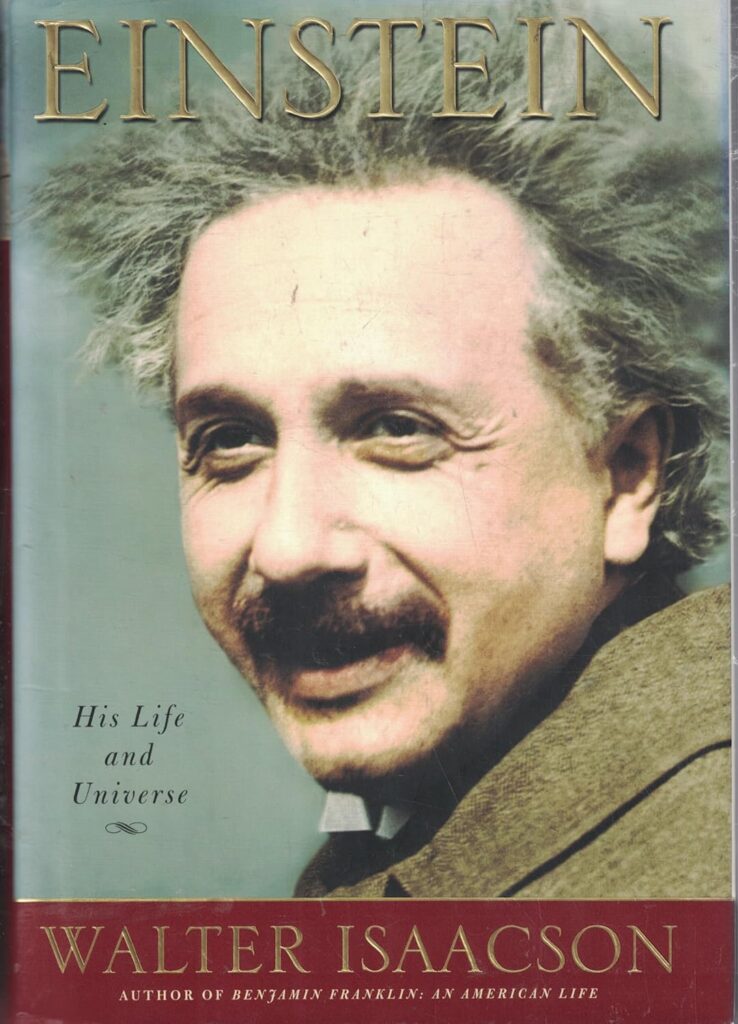
I still remember the first time I picked up “Einstein” by Walter Isaacson. It was more than curiosity that drove me through those pages—it was the hope that I might finally understand not just the theory of relativity but the man bold enough to challenge how the world saw reality itself. Isaacson’s writing stands apart because he does not settle for surface-level details or the easy myths that follow famous figures. Instead, he investigates the contradictions and quiet struggles, never losing sight of why Einstein’s story keeps mattering.
What’s powerful about Isaacson’s approach is that he asks us not just to admire Einstein’s achievements but to see the integrity and self-doubt that shaped Einstein’s work and life. Isaacson’s reputation as a biographer gives his words extra weight—he doesn’t glorify, he explains. For anyone, like me, who cares about the intersection of science, human weakness, and the quiet pursuit of truth, this is the standard for what a biography should be. It sets a challenge: can we honor genius without sugarcoating the real battles that shape discovery? The honesty in “einstein walter isaacson” makes sure we don’t look away, even when it’s easier.
Here, I’ll walk into those tensions—between brilliance and loneliness, idealism and disappointment—because that’s where the story teaches us the most. If you ever wondered what it truly costs to be original, you may find some of your answers in these pages.
Table of Contents
Walter Isaacson’s Approach: Humanizing Albert Einstein
When I first began reading the “einstein walter isaacson” biography, what struck me most was not simply the depth of Einstein’s ideas or even the dramatic turns in his life, but the steady hand Isaacson uses to guide the story. Isaacson never allows the narrative to spin into empty hero worship or wander into dense academic study. Instead, the book keeps circling back to what makes Einstein believable as a person—curious, fallible, defiant, and alone at times. Isaacson’s style makes Einstein not just memorable, but recognizable. Beneath the fame and the equations, we find someone stubborn enough to defy authority and humble enough to doubt his own triumphs Photo by Douglas Schneiders
Comprehensive Research and Sources
Isaacson’s rigor is easy to admire, but it’s the way he uses his sources that sets this book apart. He sifts through letters, published papers, diary entries, interviews, and silent facts tucked away in archives. The difference, though, is that he refuses to let the sources crowd out the story’s human core. Every letter is more than a footnote; it’s a lifeline to the messy reality Einstein lived.
Isaacson frequently pulls in voices that challenge and question Einstein’s claims. He exposes contradictions in the science and the life, without trying to smooth them over. In doing so, he follows in his own tradition of seeking multiple perspectives—something also observed in his other works, like his biography of Steve Jobs, which finds nuance in a similarly complex subject. You can see how this approach works by looking at his Steve Jobs biography review, where he pieces together innovation with personality flaws.
What stands out is Isaacson’s refusal to trust the myth. When Einstein’s recollections and official accounts start to slip out of sync (as they often do), Isaacson doesn’t duck the problem. Instead, he lays out the details, letting the messiness of real life drive the narrative—not just the need for a neat conclusion.
Blending Science and Storytelling
Isaacson is never content to give us just the facts. His writing moves back and forth between clarity and drama, science and suspense. The book reads less like a dry collection of dates and more like a textured story. Einstein’s scientific intuition—his relish for breaking the rules—shows up not only in the discoveries, but in the way he handles family, colleagues, and what he calls “the sacred curiosity.”
Isaacson’s knack for narrative pacing keeps even the densest theory within reach. He frames breakthroughs like the photoelectric effect and general relativity not as isolated events, but as scenes in a larger human story. There’s a ripple effect; the stakes in Einstein’s thought experiments spill over into the risks he takes in real life (arguing against the odds, sticking with beliefs even when faced with censure or exile).
The best part, in my view, is that Isaacson lets the contradictions stand. He gives Einstein room to be sentimental and cold, principled and prideful in the same breath—because real stories rarely fit into tidy arcs. For a deeper insight into Isaacson’s philosophy on narrative, Walter Isaacson on the role of storytellers breaks down his ideas about blending facts with human insight.
Making Complex Ideas Accessible
Maybe one of Isaacson’s greatest strengths as a biographer is that he doesn’t treat Einstein’s science like a sacred mountain only experts can climb. The “einstein walter isaacson” biography makes the bold bet that ideas—even thorny, weird, or revolutionary ones—should be available to anyone willing to keep reading.
Isaacson breaks down major breakthroughs, like special relativity or quantum mechanics, with careful metaphors and plain talk. He’ll pause the narrative to explain a scientific leap, as if he’s right there for the reader who nearly gave up at the first equation. The text never shies away from complexity, but it does sidestep the academic jargon that pushes most people away from physics.
He also grounds big ideas in the daily, sometimes boring, details of Einstein’s work and home life. Science is something Einstein does while worrying about money, or writing to a friend, or recovering from heartbreak. This makes the science unignorable—it’s woven into the fabric of life.
The best biographies (and this certainly is one) show that breakthrough ideas grow in ordinary soil. For me, this is what stays with you when you turn the last page: the sense that genius lives inside real people, in real time, facing pressures as strange as any paradox in physics. For more about Isaacson’s broader influence on biography, the National Endowment for the Humanities highlights his commitment to examining lives with depth in their profile of Walter Isaacson.
A Revolutionary Mind: Einstein’s Core Scientific Contributions
When I think about the legacy of “einstein walter isaacson,” what stands out is how Einstein’s core scientific work broke open the rules everyone else accepted. It wasn’t just brilliance—it was a stubbornness, a kind of moral clarity about the need to keep questioning. Isaacson’s book made me realize: Einstein’s science didn’t come from nowhere. It was fueled by a life full of doubts, ethical struggles, and bold steps into the unknown. These are not just textbook theories—they shaped the world I inherited. In this section, I want to look closely at the three scientific milestones that shaped both Einstein’s reputation and the direction of modern science.
Special and General Relativity: The Foundations of Modern Physics
It’s almost impossible to overstate how much Einstein’s work on relativity changed physics. Before him, people saw space and time as separate, like the sturdy walls of a room. Einstein shattered that view. In 1905, his theory of special relativity argued that time and space are tangled—and that this relationship depends on how fast you’re moving. The energy-mass equation, E=mc², became a shorthand for the strangeness, showing that huge energy lies hidden in tiny amounts of matter.
But Einstein didn’t stop with special relativity. In 1915, his theory of general relativity took another leap. Suddenly, gravity wasn’t some force that worked at a distance. Instead, it was a curve in the very fabric of space and time, shaped by mass. This bold prediction forced scientists (and honestly, the rest of us) to see the universe as an ever-changing web. If you want to know more about how this works, “Einstein’s Theory of General Relativity” breaks down the history and the math in a way that doesn’t put you to sleep.
These breakthroughs reshaped everyday things—from the navigation in our phones to how we map faraway galaxies. But what sticks with me is how Isaacson shows Einstein wrestling with his own doubts, pushing against not just the limits of science but the limits of his own thinking. For anyone looking for a simple summary, the DOE Explains…Relativity is also a good, clear resource (and honestly, I wish I’d had something like that in high school).
Quantum Leap: Photoelectric Effect and Einstein’s Role in Quantum Mechanics
Einstein’s name often gets tied to relativity, but his Nobel Prize came from something even stranger: the photoelectric effect. In simplest terms, he figured out that light can act like a little packet (a photon), not just a wave, and that these packets can knock electrons out of metal. This discovery helped launch quantum mechanics, which upended every safe “rule” that classical physics held dear. If you’re curious about the nuts and bolts, the American Physical Society’s breakdown of the photoelectric effect explains why this mattered.
But here’s the twist: Einstein stayed uneasy about quantum mechanics for most of his life. He hated the idea that some things could be random at their core—that, as he put it, “God does not play dice with the universe.” It was a statement that made him a bit of a rebel even among the rebels. I find this tension—the deep urge for order, the fight against randomness—one of the most human things about his story. He spent decades chasing a unified field theory that would tie every force in nature together, refusing to accept messy compromise.
Even now, people debate whether Einstein was right to be stubborn or if he just couldn’t let go of certainty. For a clearer dive into the science behind his prize-winning work, Britannica’s page on Einstein and the photoelectric effect captures both the moment and the challenge that followed.
Proof and Fame: 1919 Eclipse and Global Recognition
What finally turned Einstein from a respected scientist into an international star was proof—a bold experiment that paid off. In 1919, British astronomer Arthur Eddington led an expedition to photograph the position of stars during a total solar eclipse. If general relativity was right, gravity from the sun should bend starlight, making stars appear in slightly different spots. The expedition’s results matched Einstein’s predictions. Suddenly, this shy, rebellious thinker was headline news from London to New York.
I get goosebumps thinking about how this one event changed everything. Scientists now had real-world evidence that space and time are flexible. Einstein became a symbol of scientific revolution, and—thanks to global headlines and the drama of the eclipse—a household name. The Smithsonian’s article on the 1919 Solar Eclipse tells just how risky and dramatic that experiment turned out to be.
If you want to see how this milestone fits into the bigger conversation about scientific influence, you might find a kindred spirit in this article exploring the power of biography in uncovering truth.
 Photo by Chokniti Khongchum
Einstein’s fame made him a lightning rod for both praise and criticism, but what matters most is how he earned it—not by chasing glory, but by holding fast to questions that most people were too cautious to even ask.
Einstein’s Character: Curiosity, Rebellion, and Human Complexity
If you want to understand why “einstein walter isaacson” works as a biography, you have to start with the person at its core. Isaacson does not offer a sanitized version of Einstein. Instead, he draws out the contradictions, quirks, and flaws that shaped both Einstein’s creative genius and his human relationships. At the root of Einstein’s story is a restless curiosity, a strong urge to challenge authority, and a complex personal life that often bled into his work. When I read about these facets, I started to see the scientist not as a cold intellect, but as a person struggling with the same questions about meaning, loyalty, and independence that so many of us face.
A Curious Child: Early Influences and Education
 Photo by MART PRODUCTION
From a young age, Einstein stood out for his stubborn curiosity. He was famously late to talk, which worried his parents, but once he found his voice, he questioned nearly everything around him. Isaacson highlights moments—such as young Albert’s fascination with a simple compass—that shaped his lifelong habit of asking, “why?” and “what if?” No answer seemed to satisfy him for long.
Einstein’s education was far from smooth. His approach sometimes clashed with a rigid school system that valued memorization over independent thinking. Teachers found him dreamy or even rebellious—not the model student they preferred. Yet he excelled in math and science, but that came from his own reading and problem-solving, not from rote lessons. For a more detailed window into his early academic years, you might check out resources like The Early Years at the American Museum of Natural History, which highlights both the obstacles Einstein faced in school and the seeds of independent thought that would mark his future work.
His family also made a subtle but lasting impact. Einstein’s father ran an engineering business that struggled financially, but this world of gadgets, electricity, and technical setbacks became a training ground for creative thinking. At home, his mother’s love for music pushed him to learn the violin, teaching him discipline and the kind of pattern-seeking that would help in science, too. For further background, Britannica’s section on Einstein’s childhood and education adds context to how these lessons wove into his later life.
What sticks with me—both from Isaacson’s writing and the facts of Einstein’s youth—is that genius did not grow out of a perfect, supportive system. It thrived because he clung to curiosity in spite of pressure to conform.
Challenging Authority: Nonconformity in Thought and Practice
I often think about how much easier it is to go along with expectations, to play by the rules that teachers or bosses quietly enforce. In “einstein walter isaacson,” it’s clear Einstein refused to follow that path. From his teenage years, he distrusted rote authority—whether from teachers, universities, or scientific “truths” that everyone else accepted without question.
This tendency ran deep. At school, he skirted the strict Prussian discipline and sometimes openly challenged professors whose ideas he thought outdated. Later, at the Swiss Federal Polytechnic, he often skipped classes to study at his own pace, borrowing classmates’ notes and pursuing problems that interested him more than the syllabus. His habit of independent study, and the stubbornness to seek his own answers, made him a slow fit for traditional employment, too. The now-legendary period of working at the Swiss patent office was not a glamorous research job—he took it because he could not gain a university post, often in part because professors found him insubordinate.
Even after he became famous, his skepticism of authority shaped both his science and his public stances. He spoke out against nationalism, military buildup, and strict religious dogma, sometimes making himself unwelcome with those in power. Isaacson shows that, for Einstein, questioning was both method and moral stance. He was willing to risk comfort (and popularity) to stay true to what he saw. A helpful resource for seeing how Einstein’s early nonconformity linked to later victories is Albert Einstein: Overcame Early School Challenges, Won Nobel Prize.
For me, this quality is a double-edged sword. It drove breakthroughs but also made Einstein somewhat isolated, a trait that echoes throughout his personal letters and the accounts of friends who both admired and sometimes despaired at his stubbornness.
Personal Life: Relationships, Family, and Flaws
Isaacson does not downplay the messiness of Einstein’s personal life. Marriage, family, and deep friendships all shaped him—but so did divorce, distance, and self-doubt. It’s tempting to hold up Einstein’s scientific spirit as if it existed apart from regular life, but in reality, his relationships were as complex and troubled as his most challenging theories.
His first marriage to Mileva Maric started with hope and partnership. Mileva was a physicist herself, and for a while, they shared both ideas and dreams. Yet, as pressures mounted and Einstein’s attention narrowed to his work, their marriage began to fray. Communication broke down. The demands of ambition and disappointment pulled them apart. The divorce was bitter, and Isaacson points out that Einstein’s focus on science sometimes came at a cost to emotional connection and support at home.
His second marriage, to his cousin Elsa Einstein, brought a different kind of stability but not necessarily clarity. Elsa provided warmth, comfort, and protected Einstein from some of the storms of fame, but the relationship wasn’t without challenges. Einstein could be emotionally withdrawn, prone to affairs, and sometimes careless with the feelings of those closest to him. These patterns repeated with others—his children, his friends, even his colleagues.
Yet, I can’t help but recognize the honesty in how Isaacson tells these stories. Genius is never a shield from regret. In many ways, Einstein suffered from the same inability to resolve work and family that haunts anyone obsessed with their calling. The science that made him famous also made him hard to love up close at times.
For those interested in how the tangle of personal and professional life shapes public figures, the discussion in Isaacson’s biography is a masterclass. If you want to see how similarly complex personalities in science and literature have been handled, the discussion of “the art of biography and revisiting legacy” in this exploration of biography’s role in reframing history is well worth reading.
What I take from all this is not a need to excuse Einstein’s failings, but to understand them. “einstein walter isaacson” isn’t the story of a perfect mind, but of a person fighting to balance discovery with living—a struggle that, when told honestly, goes straight to the heart of what it means to be human.
Philosophy, Religion, and Einstein’s Worldview
Whenever I think about “einstein walter isaacson,” one of the strongest threads that emerges is how deeply Einstein’s science was connected to his questions about God, fate, and right and wrong. Isaacson doesn’t let Einstein become a flat “man of science” cut off from spiritual curiosity; instead, the biography unpacks how Einstein’s view of nature, morality, and the “ultimate questions” was shaped by philosophy and shaped every experiment and equation. His thoughts on determinism, pantheism, and the responsibilities of scientists link his theories to something much bigger than academic debate. If you’ve only seen Einstein as a scientist, these pages remind you he was also a relentless questioner—a person wrestling with purpose and meaning in the same breath as he asked about the speed of light or the bending of starlight.
God, Science, and Determinism
Einstein’s ideas about God and science have always been misunderstood, sometimes deliberately. He didn’t accept the idea of a personal God who answers prayers or changes physical laws based on human needs. Instead, Isaacson shows how Einstein saw science and religion intersecting at the largest scale. For Einstein, the natural world followed strict rules—it was lawful, ordered, and, to his mind, essentially determined. This goes deeper than just a scientific stance; in letters and interviews, he often repeated, “God does not play dice with the universe,” signaling his rejection of randomness at the deepest level.
This kind of determinism shaped not just his work in physics but his outlook on human freedom. If the universe operates by unbreakable laws, are our choices real, or just the result of atoms colliding? The question never left him, and it shaped how he thought about his own life and the lives of others. Walter Isaacson details how Einstein’s belief in order made it hard for him to accept quantum mechanics and its built-in uncertainty, which stood at odds with his sense of the universe as fundamentally logical.
If you want to see more on these tensions, the page on Einstein’s religious and philosophical views gives added context about how his deterministic worldview ran alongside his curiosity about ethics and meaning. These views shaped both the comfort and the struggle in Einstein’s science: he wanted explanations, not randomness, and sought unity in a divided world.
Spinoza and Pantheistic Beliefs
Isaacson doesn’t just describe Einstein’s religion in vague terms; he is specific about Einstein’s interest in Baruch Spinoza—a 17th-century philosopher whose writings became a lifelong guide for Einstein. Spinoza’s God was not a cosmic person pulling levers but the sum of the laws and beauty of nature itself. Einstein famously said, “I believe in Spinoza’s God, who reveals himself in the harmony of all that exists,” and this wasn’t just a soundbite. To Einstein, true “cosmic religion” meant being moved by the order and mystery of the universe, not expecting miracles or supernatural intervention.
 Photo by Dimitry Fadeev
This pantheistic view helped Einstein stay open to wonder while holding onto the rules of science. He spent time reading and quoting Spinoza in his letters. He used Spinoza’s ideas as a shield when critics accused him of being both an atheist and a mystic, showing that his faith was really a kind of steady humility before nature. If you’re interested in what those beliefs really meant for his daily thinking, Einstein’s Philosophy of Science breaks down how he mixed scientific curiosity with a kind of ethical and spiritual awe—a stance that set him apart even among other scientists.
This isn’t an easy path to walk. To some, Einstein’s refusal to accept both traditional faith and pure atheism made little sense. But in the “einstein walter isaacson” biography, this balancing act comes to feel like a kind of honesty—an unwillingness to pretend he had more answers than he really did.
Science as a Moral Quest
Underneath the equations and experiments, Isaacson shows Einstein as a moral thinker—sometimes proud, often worried, and never content with simple rules handed down from above. The same independence that marked his scientific work shaped his conscience. He didn’t separate science from the rest of life. Instead, he treated it as a way to seek out truth, even if that meant going against popular opinion or questioning his own assumptions.
Einstein spoke and wrote often about the ethical duties of scientists, especially as the world moved toward war and nuclear weapons. He knew that ideas have consequences and that being a scientist meant taking responsibility for how discoveries might be used or misused. In this, he mirrors Spinoza again: seeing knowledge as something that should make us better, not just smarter.
Isaacson doesn’t sugarcoat Einstein’s struggles—he often felt alone as he tried to stand up for principles when others looked away. Even when he doubted that humanity would rise to the level of its creations, he kept speaking out for peace, justice, and understanding. More on this can be found at Einstein’s Religion, which dives deeper into how his scientific and spiritual sides gave shape to his moral convictions.
If you’ve read Isaacson’s take on the responsibilities of innovators in history, you’ll notice the same thread—moral duty runs right alongside breakthrough thinking. For Einstein, knowledge was never just for its own sake. It was both burden and privilege, a call to honesty, and a steady voice reminding us what is at stake when we ask the big questions.
Activism, Exile, and Einstein’s Global Role
As I worked through Isaacson’s “einstein walter isaacson,” I kept circling back to Einstein’s public courage and moral restlessness. The world often sees him as the gentle scientist with wild hair, but this picture erases how fiercely he spoke against injustice and how hard he pushed himself (sometimes at real risk) to live his beliefs. His journey from a vocal anti-fascist in Europe, through exile from Nazi Germany, and eventually to global citizenship in America was not a quiet retreat but an ongoing act of resistance. This wasn’t a scientist watching history from the sidelines; this was a thinker who believed his role demanded action, even if it meant controversy or hardship.
Speaking Out Against Injustice
Einstein never allowed his scientific status to insulate him from the world’s problems. He spoke against racism, militarism, and tyranny at a time when silence would have been easier, if not expected. Living in Germany as the Nazi threat grew, he openly criticized the regime’s violence and discrimination—not just in private letters or whispers among friends, but in public forums and published statements. This wasn’t a simple stance; speaking out meant real danger, not just for him but for his family and friends.
He was also quick to denounce antisemitism across Europe while warning of its violent spread. His refusal to conform made him a target for Nazi hatred; his home was raided, property seized, and his name appeared on fascist death lists. That’s when exile became his only refuge. When Einstein fled Germany in 1933, it wasn’t a calculated move to protect his comfort but an act of survival for someone who refused to back down. (For a deeper account, see how Einstein renounced his German citizenship and the context behind those events at the USHMM’s newspaper archive.)
Einstein’s activism found new targets over time—he wrote against lynching and racial injustice in America, spoke for world disarmament, and supported pacifist causes even when the public mood turned against them. This need to confront power, even when it hurt his reputation or sense of safety, marked his life as much as any theory he published.
Einstein in America: From Refugee to Cultural Icon
Landing in America as a refugee, Einstein carried his history with him. Many saw him as the world’s greatest scientist, but his own sense of self revolved around much more than privilege or status. He arrived at a time when the world was coming apart, and being Jewish, stateless, and famous put him in a unique—and precarious—position.
Einstein quickly used his new status to push for the rights of refugees, immigrants, and racial minorities. He settled at Princeton but refused the ivory tower mentality. Instead, he spoke in public, donated to causes, and joined organizations that fought against Jim Crow laws and promoted civil liberties. Again and again, he chose to act—even when colleagues worried he would invite unwanted attention to himself and American science. His support for African American activists, including public friendship with Paul Robeson and Marian Anderson, bucked the quiet racism of elite institutions.
At the same time, his enormous celebrity made him a lightning rod in American politics and culture. The same press that celebrated his science was often eager to critique or misrepresent his activism, sometimes calling him naïve or radical. Isaacson makes this tension clear in “einstein walter isaacson”—Einstein did not always fit the part of a quiet, grateful refugee. He was restless, outspoken, and, frankly, sometimes hard for America to claim as its own. You can read more about his activism and how it shaped his global reputation in the AMNH’s deep dive on Einstein as a global citizen.
He went so far as to warn President Roosevelt about the potential for Nazi Germany to develop atomic weapons. This push directly led to the start of what would become the Manhattan Project. It’s a hard thing to reconcile: Einstein the pacifist signing a letter that helped spur the creation of nuclear weapons. For him, the moral risk of inaction felt greater than the guilt of involvement. But he never stopped warning about the use—and misuse—of science for destruction.
The Scientist as World Citizen
One of the most remarkable things in “einstein walter isaacson” is how Einstein’s identity changed from a national figure to something far larger: a citizen of the world. After losing his German citizenship, Einstein long resisted becoming American by passport alone. He saw the nation-state as both necessary and dangerous—a force behind progress, but also the seed of war and intolerance.
Einstein spoke often about the need for global institutions, a working United Nations, and a shared sense of responsibility that crossed borders and beliefs. He backed world government proposals and international cooperation, often at odds with the mainstream. His politics were rooted in the same ideals that guided his science: honesty, rationality, and the slow work of building trust across differences.
Even in his final years, Einstein’s activism didn’t slow. He campaigned for nuclear disarmament, open societies, and civil rights, and often used his fame to shelter scientists and intellectuals fleeing oppression. He reminded people that science was not separate from justice, and that freedom of thought depended on freedom from fear. For a richer sense of his broad public commitments, Wikipedia’s summary of Einstein’s political views sketches the major issues that shaped his stance.
His journey also carried lessons for today. There are echoes of Einstein’s moral courage in every scientist who risks telling the unpopular truth or stands against government persecution. His life asks hard questions: What sacrifices are worth making to stay true, and how far should people go to speak for those without power? I see his global citizenship not as myth but as a call to the rest of us to carry forward both the curiosity and the conscience that defined his legacy.
For another perspective on how major figures grapple with the ethical demands of public fame and private conviction, you may want to explore the discussion of “the difference between success and greatness” in this review of historical innovators and their moral choices.
Legacy and Impact of ‘Einstein: His Life and Universe’ by Walter Isaacson
When I finished Walter Isaacson’s “einstein walter isaacson,” I felt pulled in two directions—awed by the legacy of someone whose influence seemed to stretch in every direction, and struck by how the book itself reshaped the story we tell about genius. This biography didn’t just outline Einstein’s scientific feats or chart his personal life; it did something more subtle and long-lasting. It shifted the public conversation, influenced teachers and writers, and left a deep mark on the genre of scientific biography.
Critical Reception and Lasting Influence
Right after its publication, “einstein walter isaacson” became a standard-bearer in nonfiction. Critics praised the wide scope and approachable style, not just for making Einstein’s theories digestible (and honestly, sometimes even beautiful), but for refusing to gloss over contradiction. It was clear Isaacson wanted us to understand Einstein as a complete human being—one who made mistakes, changed his mind, and fought his own doubts.
Reviewers and educators often pointed out that the biography set a new bar for science writing. It combined original research (including newly released letters and archives) with a modern approach to storytelling. Isaacson’s deep reporting encouraged other biographers to break out of dry academic mold and embrace a more personal, layered narrative. Even years after publication, the book continues to be a key resource for anyone studying biography as a form. For those who want to see what distinguishes a powerful life story from a mere chronology of events, I’d recommend a look at how other books compare in the Auto-Biography genre guide.
The impact goes beyond book criticism. Teachers include it in high school and college reading lists, using its clear language to open complex scientific ideas to students who might otherwise look away. It’s not unusual to hear from readers who say this book gave them the courage to approach physics for the first time. The result is a wider, richer conversation about science and its place in society.
Shaping Einstein’s Public Image
If you ask most people what Einstein “means” today, you’ll probably hear about wild hair and E=mc²—though now, thanks in part to Isaacson, you’ll also hear about rebellion, humor, and hesitation. The book helped correct the myth that Einstein was born a genius untouched by hardship or mistakes. Instead, it presented a man who succeeded by questioning authority, risking failure, and sometimes standing alone.
Isaacson showed how Einstein’s beliefs shaped his actions—both in his science and in political life. He cared deeply about peace, justice, and free thought, standing against the grain even when it hurt him. The biography made clear that his outsider status was no accident, and that doubt could be as important as certainty. For many readers, this new image broke through the old cliché of the absent-minded savant and replaced it with something fuller.
I think this change is part of a deeper trend: a push for honesty when telling stories about extraordinary lives. Biographies now wrestle with their subjects, refusing to sanitize their achievements or ignore their failures. If you’re drawn to how science shapes identity, Exploring Atmosphere by Taylor Jenkins Reid is another example of a book that digs into the tension between accomplishment and personal struggle.
 Photo by Christian Salwa
Inspiring Future Generations
What lingers, maybe even more than the book’s style, is how “einstein walter isaacson” inspires readers to see science as something personal and open-ended. The story gives permission to be curious, to fail, and to insist on the right to ask uncomfortable questions. Students, teachers, and even working scientists write about how Isaacson’s portrait made Einstein, and by extension science itself, feel possible and alive.
In classrooms, the biography is useful not just for teaching physics or history, but for showing how hard it is to build a life of meaning in the face of real risk and doubt. The story helps students see that obstacles, setbacks, and even loneliness are not proof that you’re the wrong kind of person—but maybe that you’re on the right track. This approach to science as a living, human pursuit overlaps with other strong works of science writing, like those discussed in the Book Reviews: 12 Must-Read Titles for Literary Enthusiasts.
The biography’s message—that struggle and uncertainty aren’t flaws but facts of discovery—encourages every reader to keep going, even when the path looks impossible. In my own reading, I finished Isaacson’s book with a sense of release, grateful that a story could be this honest and still leave room for hope. This is the rare book that stays with you, changing how you see not only its subject, but your own work and worth.
Conclusion
Looking back at “einstein walter isaacson,” what stays with me is, oddly enough, not just the weight of Einstein’s discoveries but the way his story feels both personal and exposed. Isaacson refuses to hide the rough edges or the heartbreak. I finished the book with the sense that greatness and struggle are locked together—genius doesn’t mean being untouched by doubt or error. In fact, Einstein’s ability to question, to admit uncertainty, and to stand firm in his beliefs is what made his impact possible.
For anyone drawn to science, history, or the tangled process of creativity, this biography holds up a mirror. It shows how messy, lonely, and rewarding it can be to stay honest with yourself and others. Isaacson’s work matters because it refuses varnish. The story pushes me to see discovery not as a clean break from everyday worries, but as a steadier, more stubborn hope that refuses to look away.
If these reflections leave you hungry for more on how biography shapes our sense of history and identity, you might want to see how stories of survival, mutiny, and truth are handled differently in the Wager Survival and Mutiny Book Review. Thank you for sticking with me—I hope you keep reaching for stories that don’t settle for easy answers, and keep pushing for your own kind of honesty.